
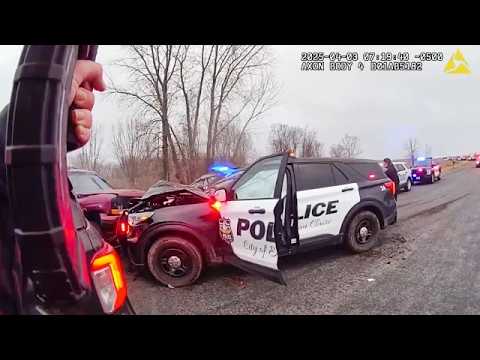
Simple Trespass Incident Takes a Horrifying Turn
Scroll down to get the original video link.
A Simple Trespass Call, and the Thing We Almost Missed
It came over the radio as the most routine call there is. Someone in the back field behind a farm property, no vehicle, no description, no urgency in the caller's voice at all. I have taken hundreds of these. Most of them are teenagers, or a hunter who wandered a fence line, or nothing at all by the time you arrive.
My name is Rosalie, and I was four years into patrol in a rural county where the calls are far apart and you learn to drive fast without hurrying. The property owner met me at the gate and pointed toward the treeline. He said he had seen someone moving out there twice in three days, and that he had almost not bothered calling the second time.
That sentence is the one I think about now. He almost did not bother. He nearly talked himself out of it, the way people do, because it seemed small and he did not want to waste anyone's time. If he had made that choice, this would be a very different story and I would not be the one telling it.
I walked the field expecting nothing. Halfway to the treeline I found a path pressed flat in the grass, going back and forth, worn in by more than one trip. Not a shortcut. A route. Someone had been walking that same line, repeatedly, for longer than three days, and something in my chest went cold and very quiet.
I found her about sixty yards into the trees. A woman, mid twenties, sitting against a fallen trunk with a jacket over her legs, and she did not run and she did not speak. She had been out there four days. She was dehydrated and hypothermic and had walked away from a situation I am not going to describe here, because it is hers and not mine.
She had been hiding, not trespassing. She had chosen a field because fields are empty, and she had been afraid to approach the farmhouse because she did not know who lived there. What the property owner had seen twice was a person walking back and forth trying to work up the courage to knock on a stranger's door.
She is alright now. That word is doing a lot of work in this sentence, and I will leave it there. The part I carry is not the rescue. It is the math. Four days, two sightings, and one man who nearly decided it was not worth a phone call.
So here is what I would ask of you. If you see something small and strange more than once, report it, even when you feel silly. Dispatchers are not annoyed by you. A trespass call that turns out to be nothing costs an officer twenty minutes and a cup of gas station coffee.
The other thing costs a person their life. Nobody knows in advance which one they are looking at, including me, including the man at the gate. He almost did not call. That is the whole story, and it is the only part I ever tell.
Comments (0)
Loading comments...
May You Like
When Road Ragers Messed With The Wrong Person

Suzuki GSXR Takes Georgia State Patrol On 130MPH Pursuit !
WHEN BIKERS FIGHT BACK! | CRAZY BIKER MOMENTS
Latest Posts
Popular Posts
WHEN BIKERS FIGHT BACK! | CRAZY BIKER MOMENTS
Sep 12, 2026

Woman Discovers Kidnapped Girl in Her Garage
Sep 12, 2026