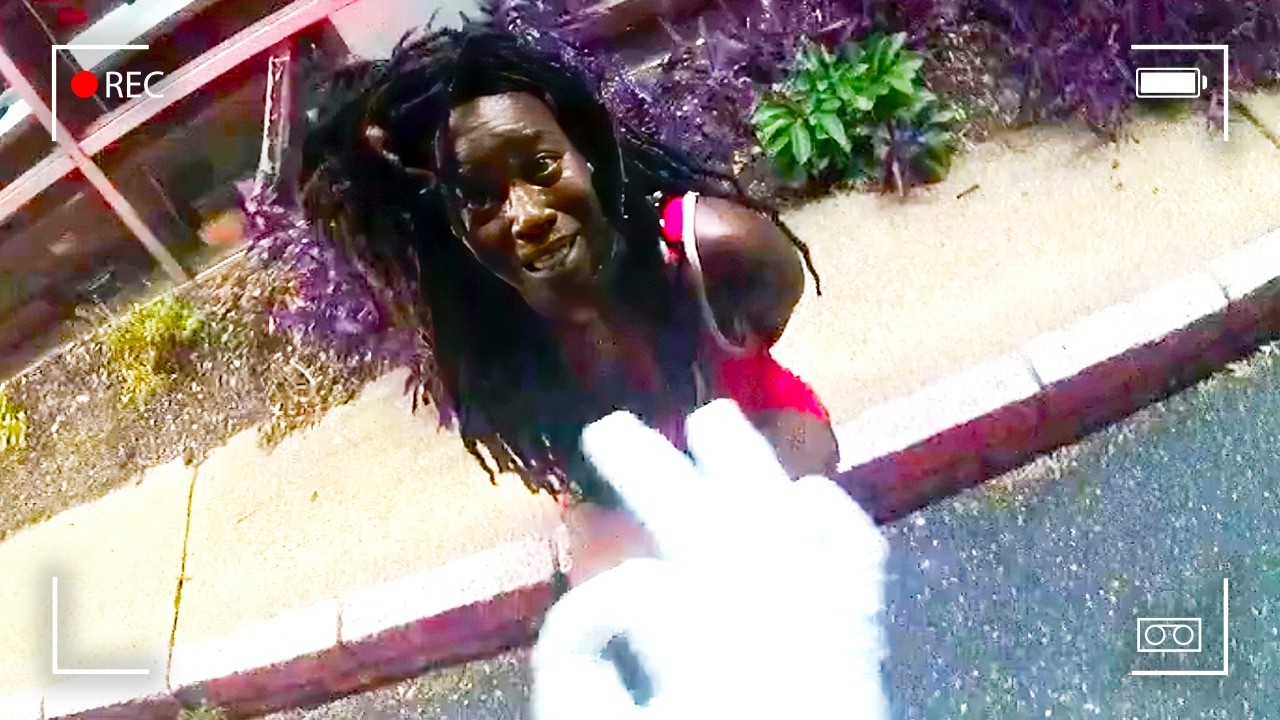
Airport Karen Loses Control and Attacks Officers Mid-Flight | Karens Getting Arrested By Police
I Was the Flight Attendant in That Video. She Was Never Charged.
The clip is thirty eight seconds long. A woman in row fourteen is screaming, there is a scuffle, and then there is a shot of her being walked off the jet bridge by two officers. The title says she was arrested. The comments are full of people saying they hope she gets twenty years.
She was released that afternoon. No charges were ever filed. She flew again eleven days later on a different carrier, because there is no shared list that would have stopped her.
My name is Renata and I have been a flight attendant for nineteen years. I want to explain what actually happens in these situations, because the arrest in the thumbnail is almost never the ending, and the gap between what people think happens and what actually happens is where my friend's career disappeared.
Let me start with the part that most passengers genuinely do not know.
I am not there to bring you a drink. I am there because in an emergency, somebody has to get a hundred and eighty people out of an aluminum tube in ninety seconds, in the dark, possibly in water. The service is a thing we do in between. It is not the job.
Every requirement of my training is built around that. Where I stand, what I am watching, why I count things, why I care so much about a bag that is not fully under the seat. All of it is about the ninety seconds that will probably never come, and that I have to be ready for on every single flight for nineteen years.
That framing matters for what follows, because when a passenger becomes a threat to that capability, the calculation changes completely, and passengers rarely understand why our tone shifts so fast.
Now the flight.
It did not start in the air. These almost never do. She had been drinking in the lounge, which we could tell within about four seconds of her boarding, and I want to be precise here because I have written this paragraph carefully.
She was not having a medical event. She was not confused, she was not disoriented, she was not searching for a word. I have dealt with all of those and they look completely different from the inside, and I am not going to soften what this was in order to make a tidier story.
She was intoxicated and she had decided that the rules did not apply to her that day, and both of those are choices that adults make.
The first flag was at boarding, when she would not stow a bag and told Gilles, our purser, that he could do it for her. He did. That is standard. We absorb an enormous amount of low grade rudeness because the alternative is a delay, and delays cost money, and we have all learned exactly how that conversation goes with the company.
That absorption is the first thing I would change about this industry if I could change one thing.
The second flag was about forty minutes in, when she was drinking from a bottle she had brought on herself. That is not a customer service matter, it is a federal regulation, because we are legally required to know exactly what every person on that aircraft has consumed.
Pilar asked her, politely, twice. Pilar is twenty nine and had been flying for about three years and is one of the most naturally calm people I have ever worked with.
The third flag was the lavatory, and the fourth was the seatbelt sign, and by the two hour mark we were in the galley having the conversation that crews have in low voices with our backs to the cabin. Gilles made the call to notify the flight deck, which is the correct call, and which starts a paper trail that most passengers have no idea exists.
Then she stood up during a descent and would not sit down, and Pilar put a hand out, palm open, at chest height, the way we are trained to.
I am not going to give you a play by play of the next ninety seconds because it is on the internet already and because Pilar has asked me not to. What I will say is that it went physical, and that Pilar took the worst of it, and that four passengers helped and I could not tell you a single one of their names.
Here is the part that is worth understanding.
Interfering with a flight crew is a federal crime. It is not a local matter, it is not a customer service dispute, and the statute carries a maximum penalty that goes into the decades when force or a dangerous weapon is involved. On paper, this is one of the most serious things a passenger can do.
On paper.
We landed. Police met the aircraft, which is standard, and they were professional and quick. She was walked off first, which is what the video shows, and that is the shot that went into a hundred compilations under the word arrested.
What being met by police actually means is that she was removed and detained. It does not mean charges were filed. Those are two very different events and the video cannot tell them apart.
Between the removal and any actual prosecution, several things have to happen, and each of them is a place where the whole thing quietly dies.
The airline has to want it. A carrier can ban a passenger internally, which is easy, cheap, and invisible. Pushing for a federal prosecution is expensive, generates press, and takes crew off the line for interviews and appearances, and crew off the line is the specific cost that gets weighed.
The regulator and the prosecutor are also different animals. The aviation authority can pursue civil penalties, which can run into serious money per violation, and that process is not criminal and does not put anyone in a courtroom. Criminal charges are a completely separate decision made by federal prosecutors who have finite resources and a great many cases.
And the crew has to be willing. That sounds like a small thing. It is not.
Being willing means giving statements, being available, potentially traveling, potentially testifying, and doing all of it while continuing to bid a schedule and pay rent. It means putting your name permanently on a public document. And it means doing that with the knowledge that a percentage of these cases go nowhere anyway.
I have watched colleagues decline to pursue for exactly these reasons and I have never once judged them for it.
In our case, the company's position was communicated to us in a tone I would describe as gently discouraging. Nobody told us not to pursue anything. Nobody would ever say that out loud. What we got was a lot of language about how the matter was being handled internally and how we should focus on our recovery.
She was banned from our airline. That is real and it matters and I do not want to dismiss it.
It is also entirely unenforceable across the industry, because there is no shared no-fly mechanism between carriers for this category of behavior. A person banned by one airline books another one the same afternoon. The only genuine no-fly list in the United States is a security list, and it is not for this.
Eleven days later, she flew. I know that because a friend of mine saw her at a gate.
Now Pilar.
She had an injury that kept her off the line for months. Workers compensation covered the medical side, which is more than a lot of workers get and which I am not going to complain about. What it did not cover is what actually ended her career.
She could not stand in a galley during boarding without her hands shaking. She tried three times. She did all the right things, she saw the right people, and after about a year she took a ground position at half the pay because she could not do the job anymore.
Twenty nine years old. Three years of flying. Gone because a woman in row fourteen decided she was not going to sit down.
And the woman in row fourteen went home. That is not a moral failure on anybody's part in particular. It is the outcome of a series of individually reasonable institutional decisions that produce, at the end, nothing.
That is what the compilation does not tell you. It shows you an arrest, and the arrest feels like an ending, and the audience gets to close the tab satisfied. The satisfaction is the product. Nobody makes a follow up video called nothing happened to her.
I became the person who files, after that.
Every incident, every time, in writing, in full, within the required window. I stopped absorbing the low grade stuff quietly. When a passenger crosses a line, it goes in a report, and I do not soften the language to keep a boarding on schedule, and I have been told more than once that I am difficult about this.
Faye Trombley, our union rep, told me something in the middle of all this that reframed it for me. She said the reason these cases evaporate is not usually a decision by anyone to let it go. It is that the file is thin. Nobody documented the first four flags. It comes down to ninety seconds with no history attached to it, and ninety seconds is easy to characterize as a mutual altercation.
So the paperwork is the thing. Not because paperwork is satisfying, but because a thick file is much harder to walk away from, and because the boarding gate incident that nobody bothered to write up is the difference between a pattern and an isolated bad day.
I want to say something about the other passengers on that flight now, because this is the part where you come in.
Almost everyone filmed. That is not a criticism, it is just an observation about what people do now, and it is why that clip exists at all. But of the roughly one hundred and eighty people on that aircraft, do you know how many gave their name and contact information as a witness?
Two.
Four people physically helped, which was genuinely brave, and I would like to thank all four of them and I cannot, because they got off the aircraft and went to their connections and I never learned who they were.
If you are ever on a flight when something like this happens, here is what is actually useful, in order.
Stay seated unless crew ask for help. An extra person standing in an aisle during a descent is a hazard, not an asset, and we are managing a cabin, not just a passenger.
If crew do ask, do exactly what they ask and nothing more. The four people who helped us did it well because Gilles gave clear direction and they followed it.
Then, and this is the one that matters, give your name and a contact to a crew member before you leave the aircraft. Say the words I saw what happened and I will be a witness. That takes eleven seconds and it is worth more than every video on that plane combined.
Because here is the thing about the footage. Video shows the ninety seconds. A witness can testify to the two hours, to the tone, to what she said at boarding, to the fact that Pilar asked politely twice. That context is what turns a thin file into a real one, and no phone captures it.
If you want to film, film. I have stopped fighting that and honestly in some situations it has protected crew. Just do not let filming be the entire contribution.
One last thing, and then I will let you go watch the clip.
I do not hate the woman in row fourteen. I have thought about this a lot and I have landed somewhere that surprises me. I feel almost nothing about her at all. She was one bad person on one bad day out of thousands of flights.
What I have real feeling about is a system where a person can end a twenty nine year old's career on a Tuesday and be on another airline the following week, and where the only permanent record of any of it is a thirty eight second video with a caption that says she was arrested, which is technically true and completely misleading.
Pilar works in an office now near the airport. She is good at it. She sees the aircraft out the window all day, which she says she has gotten used to, and I do not entirely believe her.
The clip is below. Watch it if you like. Just know that the arrest you are watching was, in every sense that matters, the end of nothing.
Full Video https://www.youtube.com/watch?v=pxKKYNJx6F0
Comments (0)
Loading comments...
May You Like
The Moment Mom With 1yo Baby Finds Out Husband’s Sick Secret

BEST OF ROAD RAGE| Most Insane Dashcam Videos of the YEAR
Police Chase Leaves 6 Patrol Cars Wrecked
Latest Posts

Popular Posts

WHEN BIKERS FIGHT BACK! | CRAZY BIKER MOMENTS
Sep 12, 2026
Simple Trespass Incident Takes a Horrifying Turn
Sep 12, 2026